
The Hidden Cost of Making Slack the Center of Everything

Recently, I read a LinkedIn post from someone who had been laid off and found herself missing Slack.
She did not miss the software itself. She missed the daily connection it represented: checking what coworkers were discussing, celebrating small wins, reacting to jokes, approving something for sales, or seeing a random update from another part of the company.
Even while on vacation or scrolling late at night, she would still open Slack just to see what was happening. After losing the job, the notifications stopped, and she realized how much those small interactions had become part of her daily life.
I have a lot of sympathy for that. Losing a job often means losing far more than a paycheck. You also lose routines, relationships, a sense of belonging, and all the small moments that made you feel connected to a group.
But the post also highlighted something else. It is not the first time I have seen how dependent people become on Slack.
Slack starts as a tool
Companies usually adopt Slack for practical reasons. It is fast, convenient, and easy to use. People love it.
But this is where the problem starts. Over time, Slack often stops being one communication tool among many. It becomes the place where everything happens.
Quick questions happen there. Important decisions happen there. Product discussions, approvals, jokes, customer updates, technical explanations, company announcements, and personal conversations all get mixed together.
Eventually, Slack is no longer just software. It becomes part of the company culture and part of people’s daily routine. It becomes a ritual.
Convenience creates dependence
There is nothing inherently wrong with enjoying communication with coworkers. Social interaction matters, especially for remote teams.
The problem begins when people stop choosing a communication method based on what the conversation actually requires. Slack becomes the automatic answer to everything because it is already open.
A complicated technical question that deserves a thoughtful discussion becomes a stream of short messages. A decision that should be documented gets buried in a channel. A project clarification happens in a private chat, disconnected from the project itself. Important context gets spread across public channels, private groups, direct messages, calls, documents, tickets, and people’s memories.
In the moment, every individual interaction feels efficient, but the company pays for that convenience later. Someone has to find the decision again. Someone has to reconstruct why it was made. A new employee has to search through months of messages. An AI assistant has to guess which conversation contains the relevant information. Two teams may continue working from completely different assumptions because the final answer was never properly recorded.
Slack makes communication easy, but easy communication is not automatically effective communication.
Replacing it becomes an emotional issue
This dependence also creates a difficult problem for managers.
Imagine a CEO looking at how the company communicates and concluding that employees spend too much time chatting, important decisions are difficult to find, and valuable knowledge is constantly disappearing into message history.
The logical response might be to reduce the company’s dependence on Slack or move certain types of conversations elsewhere. But by that point, replacing Slack no longer feels like changing software, which is stressful enough on its own. It feels like an attack on how people work, socialize, and experience the company. Employees may hear, “We need a better place for important discussions,” but emotionally interpret it as, “We are taking away the place where you talk to your coworkers.” That is a much harder change to make.
The tool has become connected to friendship, belonging, visibility, and company identity. Any attempt to limit it can feel like management is trying to control communication or remove part of the informal company culture.
This is what happens when a tool becomes the center of the universe.
Slack is good at some things
This is not an argument that Slack is useless or that companies should eliminate informal communication.
Slack is good for quick coordination, short updates, lightweight questions, and casual social interaction. And none of these is a problem.
The problem is sacrificing structured discussions and reusable company knowledge because the same tool is convenient enough to use for everything.
Slack is not especially good as a home for thoughtful discussions. Messages arrive quickly, topics drift, side conversations appear, and the most recent response naturally receives the most attention. It also does not encourage people to think carefully about where information belongs or how someone will find it six months later.
A conversation can be useful while it is happening and almost worthless afterward. That may be acceptable for a joke, a lunch plan, or a quick status update. It is much more expensive when the conversation contains a product decision, a customer commitment, a technical explanation, or a change in company policy.
Company culture should not belong to one app
A healthy company culture should come from people, shared work, trust, values, and relationships. It should not depend so heavily on one messaging platform that losing access to the platform feels like disappearing from the company itself.
The social side of work matters, but companies should be careful when social connection, operational communication, thoughtful discussion, and long-term knowledge all live in the same endless stream.
Different conversations need different structures. Chat is only useful when speed matters. A structured discussion is better when the subject requires thought, disagreement, context, or a decision.
Important company knowledge should not depend on whether someone remembers the right search term or still has access to an old private channel.
The goal is not to remove conversation from work. It is to stop treating every conversation as if it belongs in chat.
The real tradeoff
Slack became central in many companies because it reduced friction. But reducing friction in the moment can create enormous friction over time.
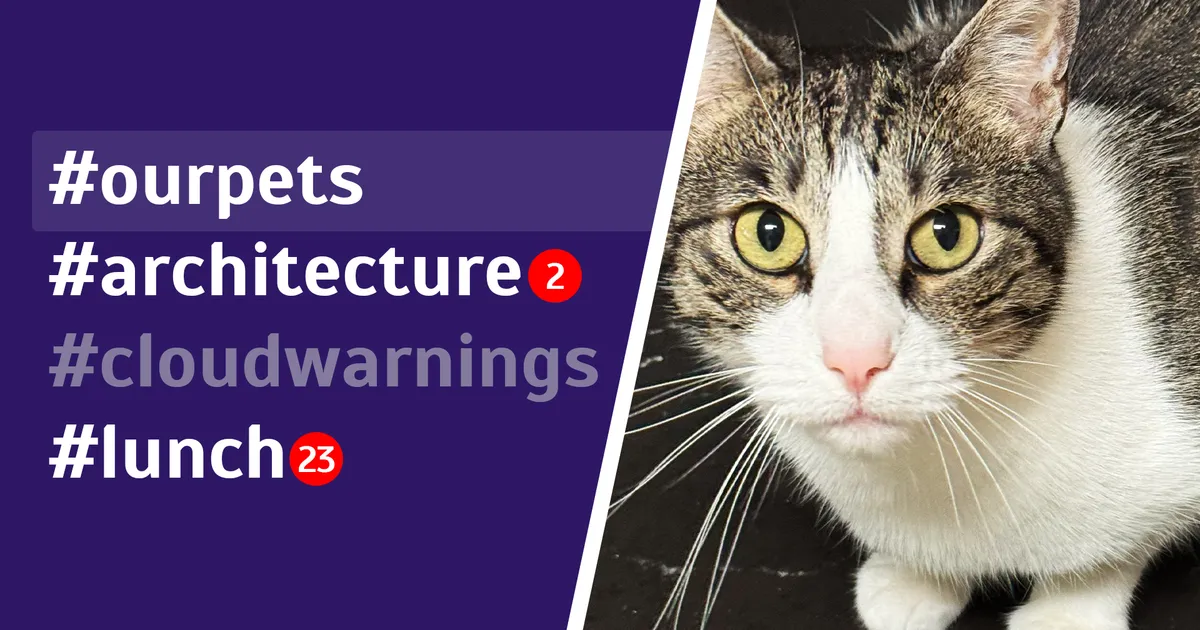
When chat becomes the default place for everything, companies slowly trade structured conversations and reusable knowledge for notifications, reactions, and the #ourpets channel.
The pets are worth keeping. Just don’t confuse a lively chat with a healthy communication system.